
Redirect Checker
Trace the full redirect chain for any URL — detect loops and issues.
Redirect Chain Tracer
Enter any URL to trace all redirects — detect 301, 302, 307, 308 chains, loops, and the final destination.
What is Redirect Checker?
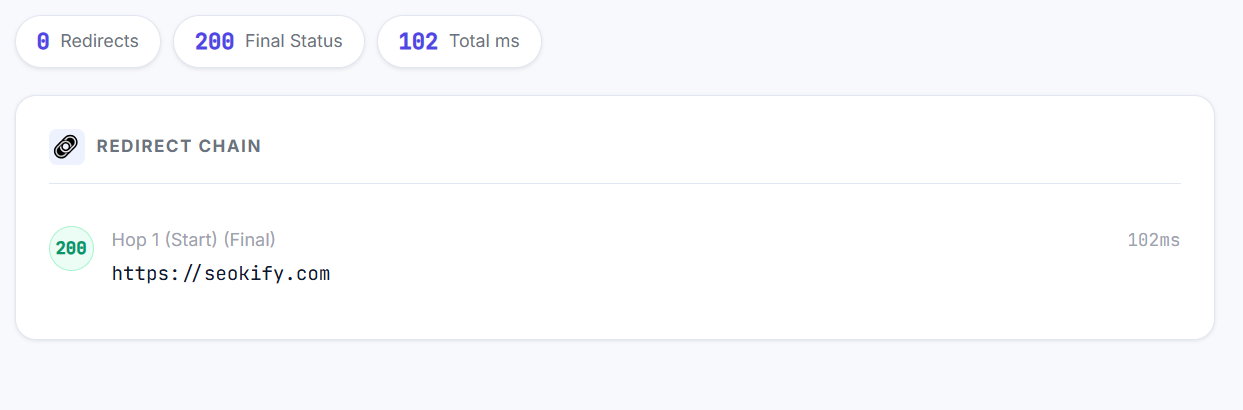
Analyze URL redirects instantly with our free Redirect Checker tool. Detect 301, 302, redirect chains, loops, and HTTP status codes to improve SEO and website performance.Traces the full redirect chain from any URL to its final destination — showing each hop HTTP status code (301, 302, 307, 308), URL, and response time in milliseconds. Detects redirect loops and chains longer than the safe 2-hop limit.
Free Redirect Checker Tool
Redirects are an important part of technical SEO and website management. Incorrect redirects, redirect chains, and loops can negatively impact search engine rankings, slow down page loading, and create a poor user experience.Our Free Redirect Checker Tool helps you instantly analyze URL redirects, HTTP response codes, redirect chains, and final destination URLs to ensure your website is properly optimized for SEO.
A proper redirect setup helps search engines understand your website structure and transfer ranking signals correctly between URLs.
What This Redirect Checker Tool Analyzes
Our tool checks:- 301 redirects
- 302 redirects
- HTTP response headers
- Redirect chains
- Infinite redirect loops
- Canonical redirect issues
- HTTPS to HTTP problems
- WWW vs non-WWW redirects
- Mobile & browser redirect behavior
Why It Matters for SEO
Each redirect hop loses approximately 10-15% of link equity (PageRank). Redirect chains compound this loss. Redirect loops crash bots and browsers. Keeping redirect chains to a single 301 is an important technical SEO practice.
Search engines use redirects to understand page changes and website migrations. Poor redirect implementation can cause:
- Loss of SEO rankings
- Crawl budget waste
- Slow website performance
- Broken user journeys
- Indexing problems
Technical SEO experts recommend avoiding unnecessary redirect chains and ensuring all important URLs return the correct HTTP status codes.
Benefits of Using a Redirect Checker
Improve Technical SEO
Ensure search engines can crawl and index your pages correctly.
Detect Redirect Chains
Avoid multiple redirects that slow down websites and dilute SEO signals.
Fix Broken Redirects
Identify invalid or looping redirects before they impact users.
Verify Website Migrations
Confirm that old URLs correctly redirect to new pages after migrations or redesigns.
How to Use This Tool
- 1 Enter the original (source) URL
- 2 Click Trace Redirects
- 3 Count the number of hops
- 4 Flatten any chain longer than 1 hop to a direct redirect
- 5 If a loop is detected, fix it immediately in your CMS or .htaccess
Frequently Asked Questions
A 301 redirect is a permanent redirect that tells search engines a page has permanently moved to a new URL.
301 = Permanent Redirect — transfers link equity and tells Google to update its index. 302 = Temporary Redirect — does not transfer link equity reliably and the original URL stays indexed.
Even a single unnecessary redirect wastes crawl budget. More than 2 hops is considered a chain and should be flattened.
Redirect chains slow down crawling and can reduce SEO efficiency by forcing search engines through multiple URLs.
Yes, the tool detects infinite redirect loops and chain issues.
Yes, this tool is completely free and available online without registration.